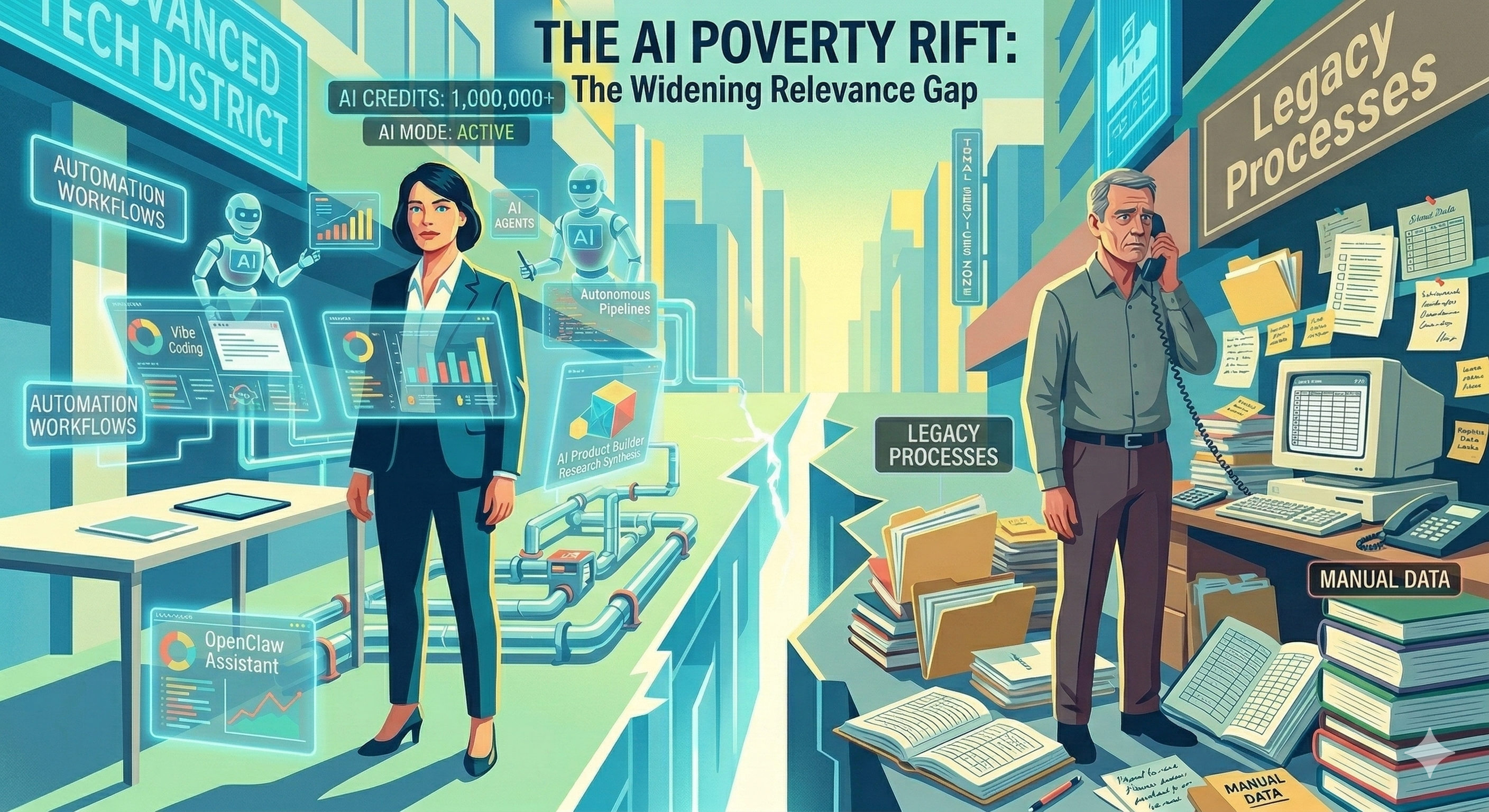
There was a time when professional worth was simple to measure. You learned a craft, sharpened it over decades, and the market rewarded your expertise. The surgeon who could feel the difference between healthy and diseased tissue. The architect who understood how light would fall through a window that existed only in her mind. The developer who could hold an entire system's logic in his head like a cathedral made of glass.
That era isn't ending. It's being rewritten.
Today, mastery alone is not enough. A second axis has emerged, one that cuts across every industry, every discipline, every rung of the professional ladder. It isn't about what you know. It's about how seamlessly you've woven artificial intelligence into the fabric of your working life. And if you haven't, you may already be suffering from something you can't yet name.
I call it AI poverty.
A New Kind of Disadvantage
AI poverty doesn't look like poverty. It doesn't announce itself with empty bank accounts or bare cupboards. It hides behind respectable salaries, impressive degrees, corner offices. It is the invisible gap between those who have integrated AI into the marrow of their professional lives and those who are still treating it as a novelty, a toy to play with on a slow afternoon.
A cardiologist earning six figures can be AI-poor. A business owner running three retail stores can be AI-poor. A senior developer at a Fortune 500 company can be AI-poor. The condition has nothing to do with wealth, education, or intelligence. It has everything to do with exposure, integration, and the willingness to reimagine how work gets done.
Through my research and observations across global professional landscapes, I've identified the forces that push people toward, or pull them away from, AI fluency.
The Professional Divide
Some professions are, by their nature, AI-distant.
Consider medicine. Medical students spend the better part of a decade buried in anatomy, pharmacology, and clinical rotations. Their relationship with technology is often transactional: electronic health records, imaging software, maybe a diagnostic app. Many doctors interact with AI the way a tourist interacts with a foreign city. Brief visits, surface impressions, no real fluency. They might ask ChatGPT to clarify a biochemical pathway or summarize a research paper, but that's where the exploration ends. The depth remains untouched.
Or consider the world of conventional business, the shop owner managing inventory by hand, the businesswoman running a textile operation with spreadsheets and phone calls, the restaurant owner whose digital life begins and ends with a point-of-sale system. These are capable, often brilliant people. But AI isn't part of their vocabulary, let alone their workflow. They're solving yesterday's problems with yesterday's tools, not because they lack ambition, but because nothing in their environment has shown them what's possible.
Customer-facing roles in banking, branch managers, loan officers, support staff, operate in tightly controlled digital environments where AI tools are often restricted by policy. Manual trades like plumbing, electrical work, carpentry, and automotive repair remain largely untouched by AI, though this is shifting unevenly across regions.
Even tech professionals aren't immune. Developers and designers working inside highly regulated industries like audit firms, financial institutions, and government agencies often face workplace restrictions that wall them off from the AI tools reshaping their own fields. They sit inside the technology industry, yet remain outsiders to its most important revolution.
Beyond Profession: The Three Multipliers
Profession sets the baseline, but three other forces determine where you actually land on the AI spectrum.
Environment is the first. Your workplace can be a launchpad or a cage. Compliance requirements, locked-down systems, organizational inertia: these can leave even the most technically capable professional AI-poor from nine to five. Some companies treat AI as a strategic priority. Others treat it as a security risk. The difference between these two postures will define which organizations survive the next decade.
Motivation is the second, and arguably the most powerful. The professionals who escape AI poverty almost always share one trait: they refuse to let their employer's limitations define their personal trajectory. They experiment at night. They find free-tier alternatives. They build side projects. They treat every new AI tool as a puzzle worth solving. This entrepreneurial restlessness, the refusal to accept the boundaries of the given, is the single greatest antidote to AI poverty.
Financial resources are the third, though their influence is smaller than most people assume. Yes, AI tools cost money: subscriptions, API tokens, computing infrastructure. But the motivated individual consistently finds workarounds through open-source models, free tiers, and community-built alternatives. Money helps. It isn't destiny.
Two Frameworks for Navigation
To make this landscape legible, I've developed two conceptual tools.
AI Credits
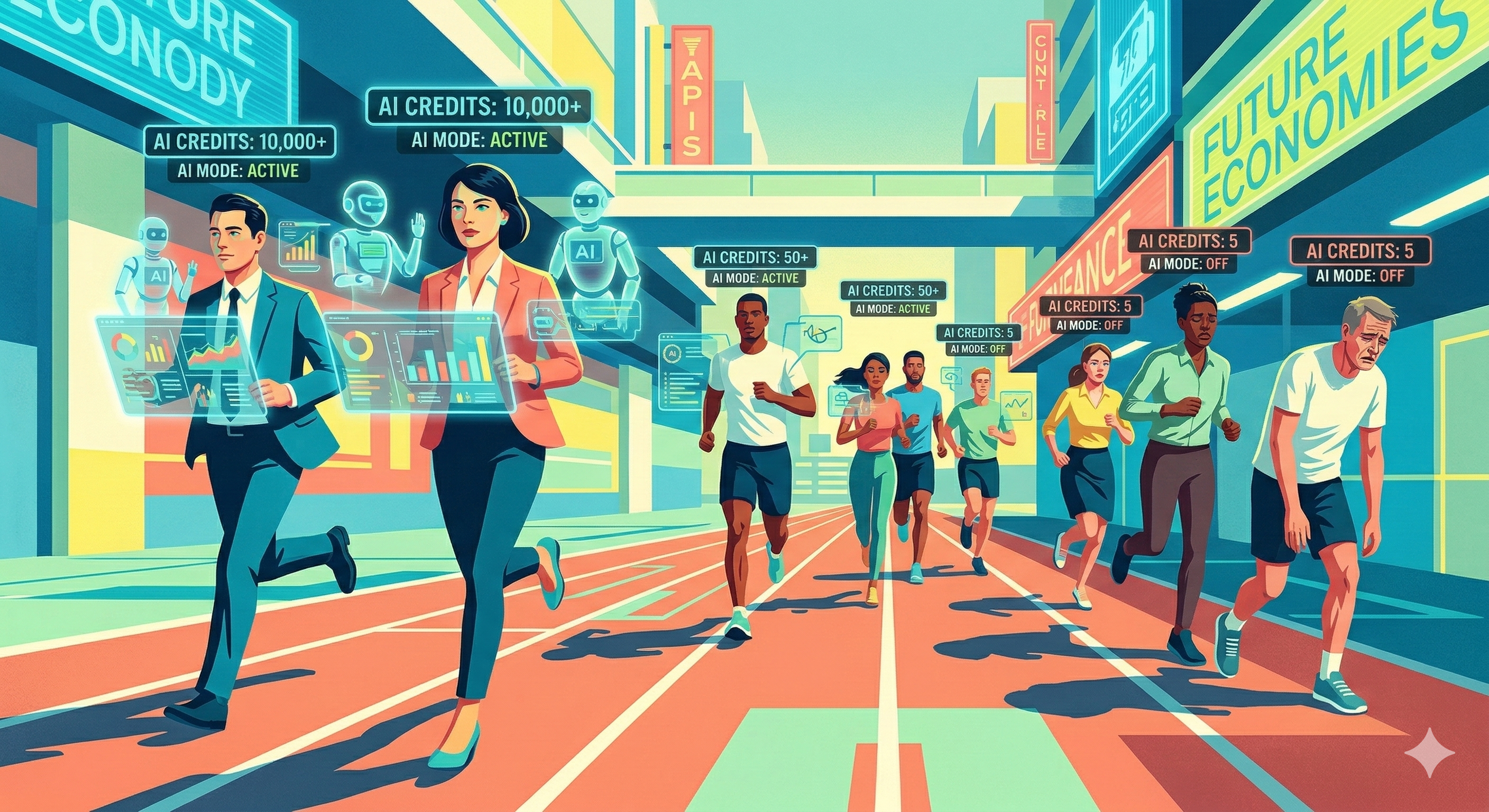
Think of AI credits not as currency, but as a measure of integration depth, a running score of how deeply AI has penetrated your professional and personal life. You accumulate credits by automating the tactical: email triage, scheduling, research synthesis, data cleaning. You earn more by deploying AI agents for complex, multi-step workflows. You earn the most by building systems where AI operates continuously in the background, handling the routine so you can inhabit the strategic.
The more credits you carry, the less vulnerable you are to displacement. These credits represent something money can't directly buy: the compound effect of daily practice, accumulated intuition about what AI can and cannot do, and the muscle memory of delegation.
AI Mode
AI mode is a state of focused, intentional engagement with AI tools and capabilities. For me, it's four to five hours daily, not passive scrolling through AI news, but active deployment: learning new platforms, building automation pipelines, experimenting with workflows, pushing the boundaries of what I can delegate.
Entering AI mode regularly is not optional for anyone in a field that AI can touch. And at this point, that's nearly every field. For a UX designer and AI-driven researcher like myself, skipping AI mode feels like a surgeon skipping rounds. The knowledge atrophies. The gap widens. The world moves on.
The Spectrum of Engagement
Not everyone engages with AI at the same depth. The spectrum is wide, and the distances between its points are growing.
Casual users have heard of AI. They've tried ChatGPT, maybe Claude or Gemini. They use it the way people used Google in 2004, for quick answers, curiosity-driven queries, the occasional homework shortcut. AI is a tool they visit. It is not a tool that lives with them.
Intermediate users work in environments where AI is part of the job. They use Copilot to write code, Midjourney to generate concepts, AI-driven analytics platforms to inform decisions. Their exposure is real, but often bounded by their employer's toolset and imagination. They're literate, not fluent.
Power users occupy a different universe entirely. They've built systems where AI agents manage client pipelines, draft proposals, schedule meetings, research competitors, and execute multi-step workflows, all without human intervention. Some are running lean companies with AI handling roles that would have required five employees two years ago. They don't just use AI. They architect with it.
The Exponential Race
Here is what makes AI poverty uniquely dangerous: the race is exponential, not linear.
Each year doesn't bring incremental improvement. It brings capabilities that would have been dismissed as science fiction twelve months earlier. Voice clones indistinguishable from the original speaker. AI-generated films that audiences can't differentiate from human productions. Music composed, mixed, and mastered without a single human hand touching a fader.
And then there's what's happening to the interface itself.
The Disappearing Screen
This may be the most consequential shift of all, and most people haven't noticed it yet.
For decades, the human-computer interaction model has been remarkably stable: you sit at a machine, you open an application, you click, type, drag, scroll. The computer is a place you go to. A destination. A separate room in your life that you enter and exit.
That model is dying.
Products like OpenClaw represent a fundamentally different philosophy, one born from a deceptively simple insight rooted in deep user research: people don't live in apps. They live in conversations. The platforms they open most frequently, the ones they check reflexively, compulsively, instinctively, are WhatsApp, Telegram, iMessage. These aren't productivity tools. They're extensions of human relationships. They're where life happens.
OpenClaw's genius is placing AI exactly there, inside the chat threads you already inhabit. No new app to download. No interface to learn. No browser tab to keep open. You simply message AI the way you'd message a colleague, a friend, an assistant who happens to be extraordinarily capable. Send a text. Record a voice note. Start a new chat for a new project. The AI lives where you live.
Of course, there's a machine behind the magic. OpenClaw requires a running system, a laptop, a Mac Mini, a home server, something always on, always connected, gathering context and memory, ready to execute the moment you send a message. Your computer stays open at home, humming quietly in the background, while you carry nothing but your phone and your intentions. The machine does the heavy lifting. You do the living. That division of labor is the entire point.
The implications are staggering.
Imagine you're at a concert. The music is loud, the lights are low, and you have two hours before you need to be home. You pull out your phone and send a WhatsApp message to OpenClaw: "Build me a landing page for the freelance brand we discussed. Use the copy from last week's thread. I want it deployed by the time I'm home." You put your phone away. You enjoy the show. Back at your apartment, your machine has been working the entire time. When you walk through your front door, the landing page is live.
Or consider this: you give OpenClaw access to your email, your resume, your portfolio, and your job preferences. Then you tell it to apply to a thousand relevant positions. Not ten. Not fifty. A thousand. It reads job descriptions, tailors cover letters, matches your experience to requirements, submits applications, all running on your machine at home while you sleep, or work, or live your life. Your touchpoints? A single message to start. An occasional check-in to review progress. That's it.
Or client acquisition: OpenClaw monitors your target market, identifies leads that match your ideal customer profile, drafts personalized outreach, and manages follow-ups, all through a Telegram chat, all powered by your always-on machine working behind the scenes. You're not staring at a CRM dashboard. You're having a conversation with an intelligence that never forgets, never tires, and never drops the ball.
The user touchpoints are collapsing. The screen, the keyboard, the mouse, the browser: these intermediary layers between human intent and digital action are thinning to the point of transparency. What remains is something almost primal. A person expressing what they want, in natural language, and an intelligence making it happen.
This is not a feature upgrade. This is an extinction event for the old model of human-computer interaction. And it changes everything about how we measure professional competitiveness. The question is no longer "how skilled are you with computers?" It's "how effectively can you direct an intelligence that handles the computers for you?"
What This Means for Professional Worth
In this landscape, your worth is increasingly determined by your AI credits, your depth of integration, your ability to enter AI mode consistently, and your skill at delegating the tactical to AI while you operate at the strategic layer.
This isn't about replacing human creativity or judgment. The surgeon still needs to feel the tissue. The architect still needs to see the light. The entrepreneur still needs the instinct for what the market wants before the market knows it wants it. What's changing is everything around those irreplaceable human moments. The research, the scheduling, the drafting, the analysis, the communication, the logistics: all of it can be delegated. All of it should be.
The professionals who understand this are building leverage at a scale that was previously only available to people with teams and budgets. A single person with deep AI integration can now produce the output of a small company. That's not a prediction. It's already happening.
The Path Forward
For those who recognize AI poverty in their own lives, the prescription is clear, and it demands action, not contemplation.
Enter AI mode daily. Not weekly. Not when you feel inspired. Daily. Make it as non-negotiable as checking your email. Four to five hours of intentional engagement with AI tools, workflows, and capabilities. This is where the compound interest of competence accumulates.
Build your AI credits relentlessly. Every task you automate, every workflow you delegate, every system you build adds to your reservoir of capability. Start small with email management, scheduling, research. Then graduate to complex workflows: multi-step agents, automated pipelines, AI-driven decision support.
Understand the difference between chatting and building. Casual conversation with ChatGPT, Claude, or Gemini is an entry point, not a destination. But make no mistake: these are extraordinarily powerful tools. Professionals are using them to automate entire workflows, generate and iterate on complex code, synthesize research across hundreds of sources, and build sophisticated multi-step processes. The entry point is the casual chat. The destination is deep integration. The same tools can take you to both places. The difference is how you use them.
Build systems, not habits. Don't just ask AI for answers. Build automated systems that continuously deliver value without your ongoing attention. The goal is not to use AI more. The goal is to need less of your own time for the work that AI can handle.
Keep growing, even when your workplace can't. Many organizations restrict AI for entirely legitimate reasons. Client confidentiality, financial data privacy, regulatory compliance: these are real concerns that deserve respect. If your employer has drawn a line around AI usage, understand that they may be protecting sensitive information that shouldn't be exposed to external systems, and that's the responsible thing to do. But their institutional boundaries don't have to become your personal ones. Outside of work, the field is wide open. Your evening experiments, your weekend projects, your personal learning: these are the investments that keep you sharp, adaptable, and ready for whatever comes next. Your employer's policy protects their data. Your personal practice protects your future.
Conclusion
AI poverty is real. It is invisible. And it respects none of the traditional boundaries we use to sort people into categories of advantage and disadvantage. A well-compensated professional can be profoundly AI-poor. A resourceful individual with nothing but a smartphone and motivation can be extraordinarily AI-rich.
We are living through a fundamental recalibration of what it means to be valuable. The old currencies, degrees, titles, years of experience, still matter, but they are rapidly being outweighed by a new one: the depth and sophistication of your AI integration.
Those who accumulate AI credits, who enter AI mode with discipline and curiosity, who embrace tools like OpenClaw that collapse the distance between intention and execution: these are the people who will thrive in what comes next.
Everyone else faces a new kind of poverty. Not of money. Not of education. Not of opportunity.
Of relevance.
The race has no finish line. But it does have a widening gap. And the only question that matters now is which side of that gap you're building your life on.